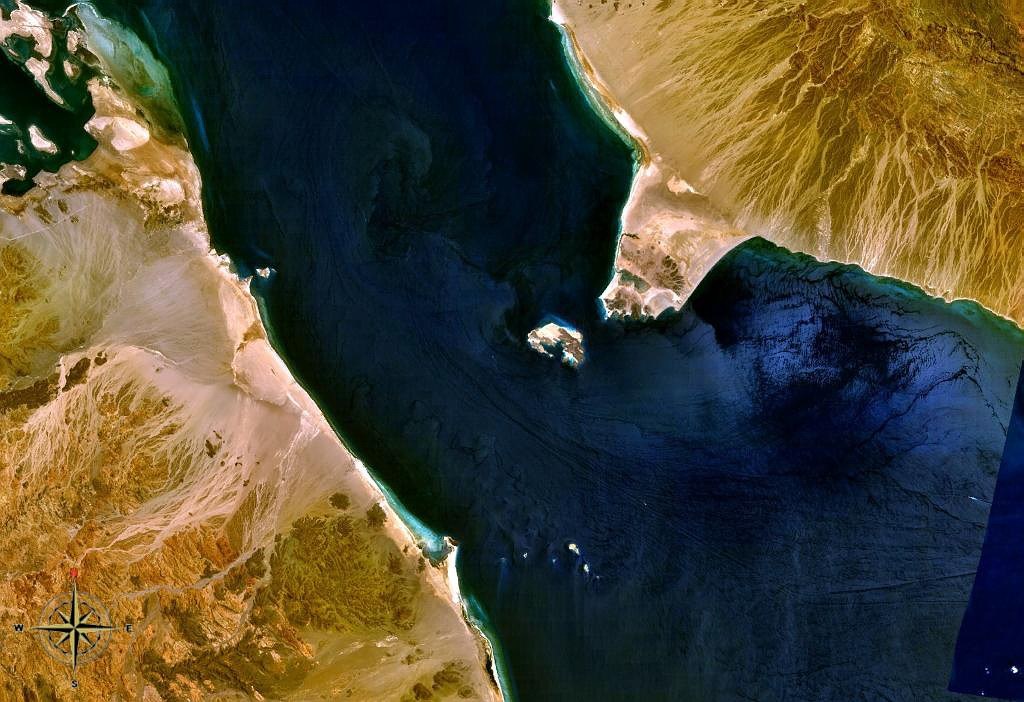
The opening days of October placed three different activities around Bab al-Mandab in the same news cycle: protection of merchant ships, military planning in Yemen and reception of people crossing toward Djibouti. Italy’s October 2 request for more EU naval resources and the UN’s humanitarian briefing illustrate how a single passage connects institutions with very different responsibilities. Source report
The strait links the Red Sea to the Gulf of Aden, between Yemen and the Horn of Africa. Cargo vessels pass through it as part of longer international routes, while people fleeing conflict cross between the two shores. Sharing the same waters does not mean that their journeys are managed by the same authorities or exposed to identical risks.
For the Horn, the connection is immediate. Coastal ports, communities receiving arrivals and maritime-security forces operate within the same regional geography. The October developments make that relationship visible through actual tasks: escorting a ship, transporting a family after arrival and coordinating the institutions responsible for assistance. The history of the corridor explains why those tasks repeatedly converge.
The corridor behind the October developments
From Suez to Bab al-Mandeb
The strait became more important after the Suez Canal opened in 1869. Suez shortened the sea route between Europe and Asia, and Bab al-Mandeb became the southern gate of a corridor connecting the Mediterranean, Red Sea, Gulf of Aden and Indian Ocean. The canal transformed shipping. It also magnified the strategic value of the narrow passage at the Red Sea's southern end.
The modern numbers show the scale. The U.S. Energy Information Administration estimates that 9.3m barrels a day of crude oil and petroleum products passed through Bab al-Mandeb in 2023. That volume fell to 4.1m barrels a day in 2024 and was about 4.2m in the first half of 2025. The fall reflected the disruption that followed Houthi attacks on commercial shipping from late 2023. More traffic was diverted around the Cape of Good Hope, a longer and more expensive route.
The energy figures capture only one part of the corridor. Container ships, bulk carriers and other commercial vessels also depend on the Suez-Red Sea route. When companies avoid Bab al-Mandeb, voyage times lengthen, insurance costs can rise and ships, crews and cargo spend more days at sea. Those effects can eventually appear in freight rates and delivery schedules far from the strait itself.
A security system built after 2023
The latest security architecture emerged rapidly. In December 2023 the United States announced Operation Prosperity Guardian under the Combined Maritime Forces after a series of Houthi attacks on commercial vessels. The European Union followed with Operation ASPIDES in February 2024. The EU describes ASPIDES as purely defensive. Its mandate is to protect ships, accompany vessels and improve maritime situational awareness. It does not include strikes on land.
That distinction matters. Different naval missions can occupy the same waters while operating under different authorities. A counter-piracy patrol, a national escort mission and a defensive EU operation may all protect shipping, yet their legal mandates, rules of engagement and political objectives differ.
By August 2026 ASPIDES said it had supported more than 2,390 merchant vessels and provided close protection to more than 720 ships since its launch. Its September updates continued to report safe passages by merchant vessels under EU protection. The scale suggests that the Red Sea crisis has evolved from a temporary emergency into a durable security burden.
The Horn side of the chokepoint
For the Horn of Africa, the importance of Bab al-Mandeb is often obscured by coverage that treats the Red Sea crisis mainly as a Middle Eastern or European trade issue. Djibouti sits directly beside the strait. Eritrea has a long Red Sea coastline. Puntland lies along the Gulf of Aden immediately east of the passage. Shipping that leaves the Red Sea enters the same maritime space used by ports, fishing communities and security forces across the Horn.
That creates several channels of exposure. The first is commercial. Ports and coastal economies depend on predictable maritime traffic. The second is security. More naval activity can strengthen surveillance while also producing a crowded operating environment in which several states and missions work side by side. The third is humanitarian. People fleeing Yemen can cross toward Djibouti in the same waters in which commercial vessels and warships operate.
The fourth is strategic competition. Djibouti hosts foreign military facilities because of its location. The strait sits close to trade routes connecting the Gulf, East Africa, Europe and Asia. That geography ensures that outside powers remain interested in the Horn even when their immediate concern begins elsewhere.
The migration corridor
The movement of people makes the strait especially difficult to reduce to a trade statistic. In 2015, when war in Yemen intensified, thousands crossed toward Djibouti. UNHCR established reception arrangements around Obock and Markazi. At the same time, migrants from the Horn continued to move in the opposite direction toward Yemen and, for many, onward toward labour markets in the Arabian Peninsula.
The same pattern survives today. Yemen can be a destination, a transit country and a source of displacement at the same time. A small boat crossing therefore cannot be understood without asking who is travelling, in which direction and under what legal or economic circumstances.
Migration and shipping figures need to remain analytically separate even where the geography is shared. The systems interact, but they measure different movements, risks and institutions.
The economic transmission
The next phase of the Bab al-Mandeb story will turn on four questions. The first is whether commercial shipping returns to the route at scale or continues to favour longer passages around Africa. The second is whether the current naval presence becomes a semi-permanent feature of the Red Sea. The third is whether fighting in Yemen produces sustained refugee movement toward Djibouti and other parts of the Horn. The fourth is whether piracy and other maritime crime exploit the same insecurity.
The answers may move independently. Shipping could recover while migration worsens. Piracy could increase even if Houthi attacks decline. Naval protection could remain after commercial traffic normalizes. A clear account therefore needs more than one headline and more than one dataset.
For Puntland the transmission mechanism is especially direct. Bosaso is a Gulf of Aden port whose commercial relevance depends on safe access to regional sea lanes. A vessel does not need to call at Bosaso for disruption at Bab al-Mandeb to matter. Higher insurance, longer routes, naval warnings and changing traffic patterns can affect the wider maritime economy in which the port operates. The effect therefore reaches Puntland even when the immediate fighting is hundreds of kilometres away.
Bab al-Mandeb matters because several systems are compressed into one narrow passage. Trade, energy, migration, war and diplomacy all pass through the same geography. For the Horn of Africa, the strait is not an external crisis observed from a distance. It is part of the region's own economic and security environment.