The International Maritime Organization said on October 2 that 44 seafarers had been freed from HONOUR 25, SEAMULL, also known as SIBU 1, and EUREKA. The agency’s account leaves 22 crew members aboard ASANA still in captivity.
The IMO reported that five HONOUR 25 seafarers died in the crossfire of the September 29 rescue. Puntland authorities said pirates killed the men before the ship was retaken, according to Reuters. The deaths leave bereaved families awaiting the return of their relatives alongside the families preparing to receive survivors.
Puntland authorities also reported taking 16 suspected pirates into custody and said four crew members were injured, the Associated Press reported. The next stages involve medical care, arrangements for survivors to return home and the handling of suspects. Each stage requires a different institution to take responsibility once armed personnel have secured a ship.
From one recovery to a wider campaign
The new account follows the recovery of Sibu 1 reported on September 25. In that case, PMPF commander Mohamed Jama told Reuters that a two-day operation had recovered the tanker seized in August. The earlier PUNT NEWS report traced the seizure to an August 20 incident recorded east of Al Mukalla in Yemen. A vessel taken on one side of the maritime corridor had become an enforcement case for authorities on the other.
That sequence explains why a ship recovery reaches beyond the point where an armed boarding ends. A hijacked vessel can move through waters used by several coastal states and by ships operating under different flags. Crew members, owners, security forces and consular officials then have separate responsibilities. Restoring control of the vessel begins the work of establishing what happened to the people aboard and arranging their release from the consequences of captivity.
Puntland’s September maritime operation had already placed renewed patrols and anti-piracy enforcement on the regional agenda. The subsequent recoveries extend the account from patrol activity to ships and crews brought out of captivity. The distinction matters because deterrence, rescue, evidence gathering and criminal proceedings are connected tasks with different requirements. A patrol can interrupt a threat; a prosecution requires an evidentiary record that survives after the operation.
The geography makes coordination unavoidable. Ships entering the Gulf of Aden from Bab al-Mandab pass through a maritime space shared by commercial traffic, fishing communities and naval missions. Puntland’s coast forms part of that space, while the routes extend toward Yemen and the wider Indian Ocean. Reports from a ship, intelligence collected ashore and information exchanged between authorities therefore have to be brought together to follow a case across jurisdictions.
The work behind maritime enforcement
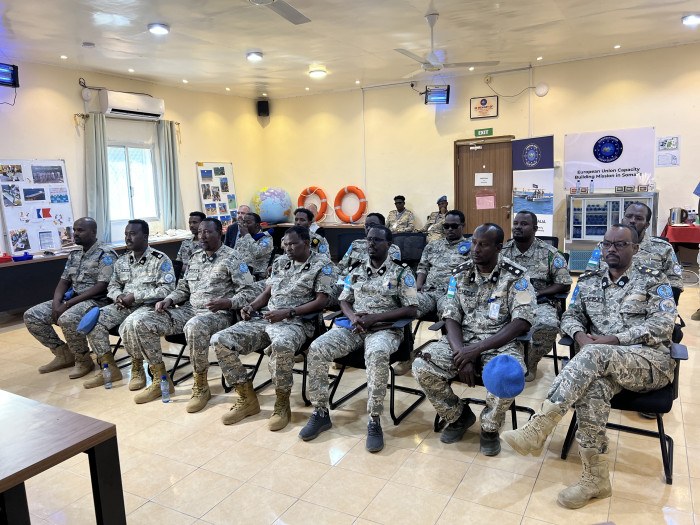
A December 2025 EUCAP Somalia account describes training for 15 PMPF commanders covering navigation, radio communications, rescue, maritime law and reporting. The programme illustrates the range of skills maritime enforcement requires. The relevant institutional connection is the combination of seagoing activity with communication, legal responsibilities and a record that other authorities can use.
The seafarers’ governments are now working with shipowners and the relevant authorities to arrange repatriation, the IMO said. Secretary-General Arsenio Dominguez also urged those responsible for the seriously injured to provide treatment and recovery support. For the survivors, reaching shore therefore leads into medical care, contact with relatives and arrangements for the journey home. The operation’s consequences continue through the institutions responsible for each part of that return.
The same distinction applies to the surrounding security picture. The earlier Sibu 1 report placed piracy alongside the separate missile and drone threats affecting Red Sea shipping. Those threats can interrupt the same trade route, although their methods and the responses they require differ. Escorting a merchant vessel through a missile-threat area and investigating an armed hijacking involve different capabilities, legal questions and chains of command.
Bab al-Mandab connects these maritime systems without making them interchangeable. Shipping companies need information about the specific hazard on the intended route. Coastal authorities need workable arrangements for exchanging reports and handling the consequences of an incident. The presence of several security missions makes clear allocation of responsibility more important because a commercial passage can cross their operating areas.
The IMO is also working with flag states on the welfare of those still held and is supporting regional maritime capacity through the Djibouti Code of Conduct. Cooperation between coastal authorities and the states responsible for a vessel links the recovery operation to the continuing protection of its crew.
The current recovery campaign consequently has several outcomes that should remain distinct: ships returned to control, surviving crew members brought out of captivity, injured people needing care and suspects entering custody. The deaths aboard HONOUR 25 require their own account. The crews still held require continued attention. For the families involved, the practical completion of a rescue is the safe return of the person who went to sea.