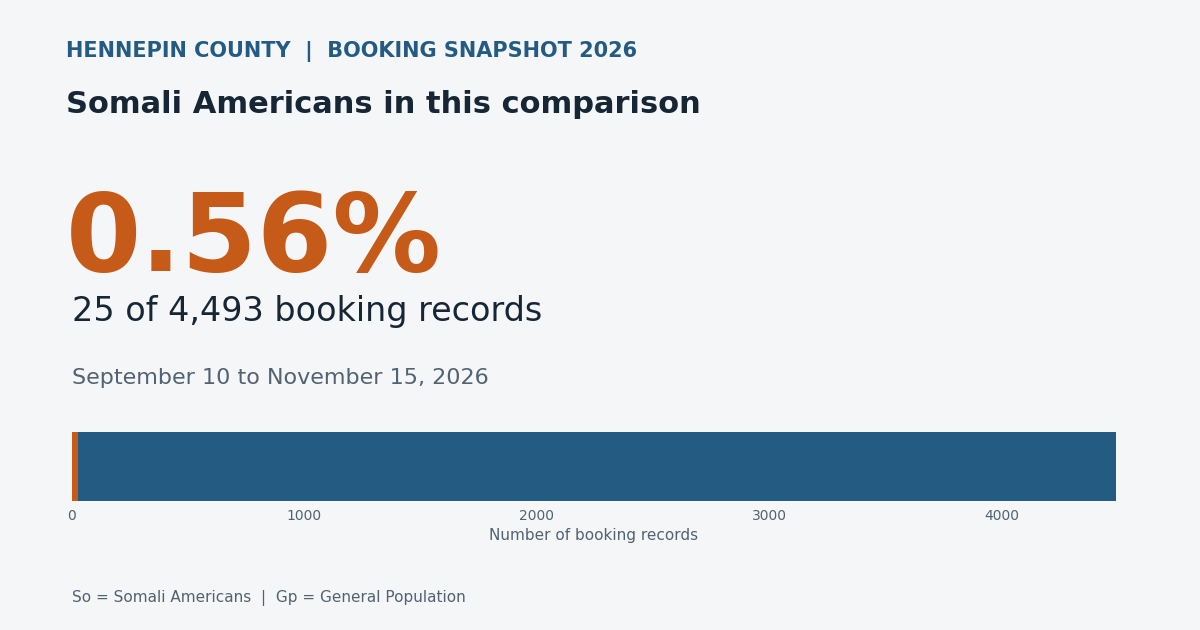
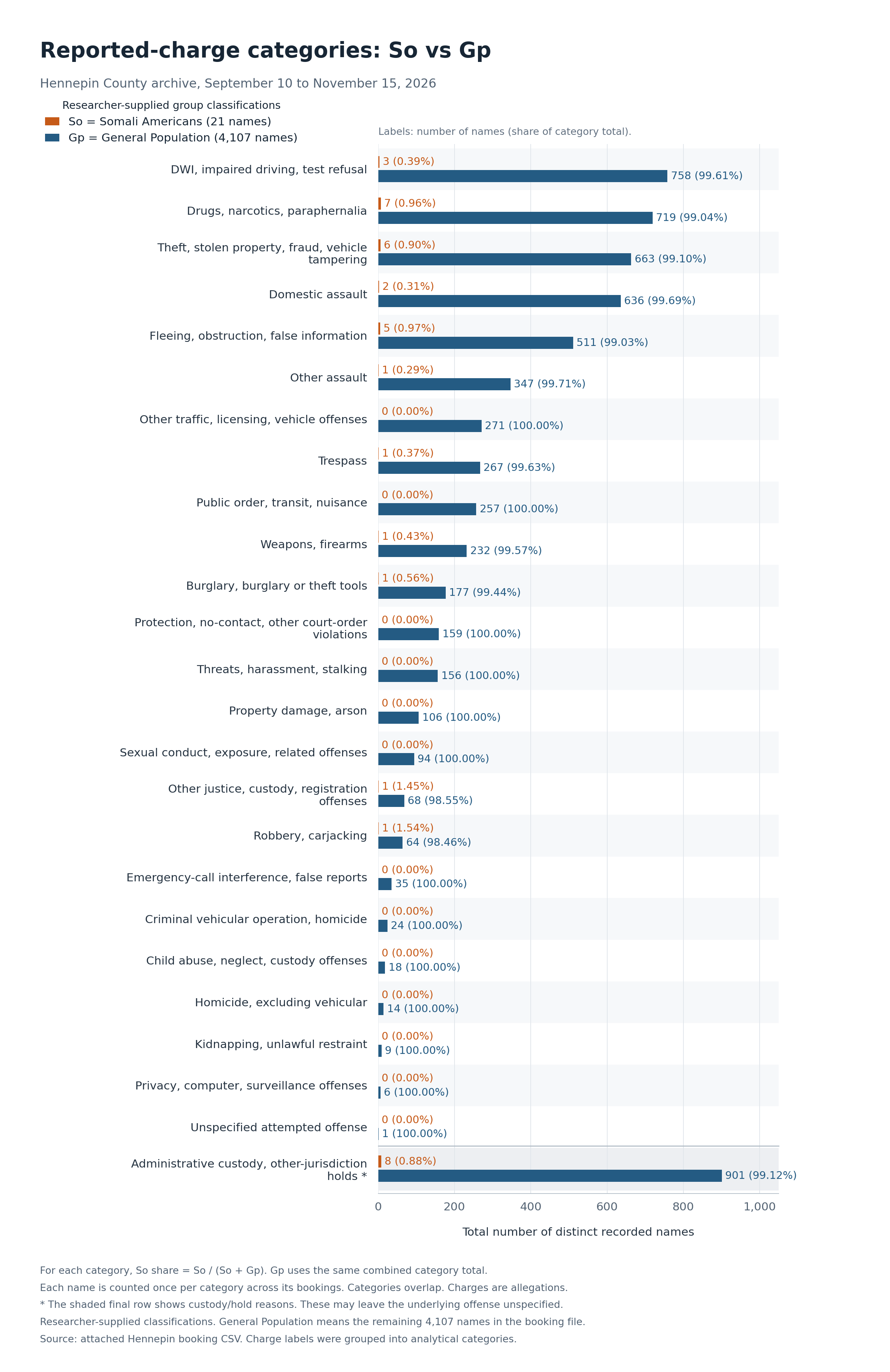
In the Hennepin County booking dataset examined, the 21 names identified by the researcher as Somali American were associated with 25 of 4,493 bookings, or 0.56%. These Somali Americans were associated with less than 1% of bookings in 19 of the 24 offense categories, with administrative custody holds considered separately.
The underlying counts give substance to that finding. Drug-related allegations appeared in eight bookings associated with the selected names, compared with 774 bookings associated with other names. For the broader theft, stolen-property, fraud and vehicle-tampering category, the figures were eight and 715. Impaired driving and test refusal produced three and 772. Every offense category contained fewer bookings associated with the selected list than with the remainder, and the selected list’s largest category share was approximately 1.49%.
These categories are analytical groupings of reported charge labels. A booking can fall into more than one category when it contains several allegations, so the category counts cannot be added to produce a new booking total. The overall 25-booking figure counts each matched booking once. Keeping those units separate allows a reader to check the small overall share against the detailed pattern.
The collection comes from a County Crime Watch download dated November 15, covering records dated September 10 to November 15, 2026. Its scope matters to the interpretation. The comparison follows a researcher-supplied list of 21 names; other Somali Americans may appear among the unmatched records. The results describe this selected cohort. They supply a concrete finding about the archive without determining a countywide ethnic crime ranking or establishing citizenship.
Precision also requires separating a booking from a finding of guilt. County Crime Watch’s transparency statement describes its material as public arrest information and preserves the presumption of innocence. A booking records a stage in an individual’s encounter with the justice system. Repeated bookings, several reported charges and eventual court decisions require different counts. Treating every entry as a proven offense would attach a conclusion to the record before the judicial process had established it.
Custody holds illustrate why those distinctions have practical consequences. The separate holds row contains eight selected names and 901 other names. Hennepin County’s sheriff describes holds as detention orders that can involve warrants and probation or parole matters. The row records custody circumstances whose underlying offense may be unspecified. Combining those entries indiscriminately with offense categories would obscure the question the comparison is intended to answer.
The appropriate public response is individual judgment grounded in the actual record. Anyone discussing Somali Americans through these figures should identify the selected cohort, state the period and distinguish reported allegations from convictions. The same standard should govern discussion of every community. A person’s name or ancestry cannot supply evidence about another person’s conduct, and a demographic label cannot decide the merits of a criminal case.
A broader study could extend this work through complete, consistently defined groups, suitable population figures and comparable periods. For now, the finding is specific: the 21 selected names were associated with a small share of this booking snapshot, including under 1% of bookings in most offense categories. Reporting that result accurately preserves its value. Public debate gains from figures that can withstand examination and from judgments directed at individual conduct.